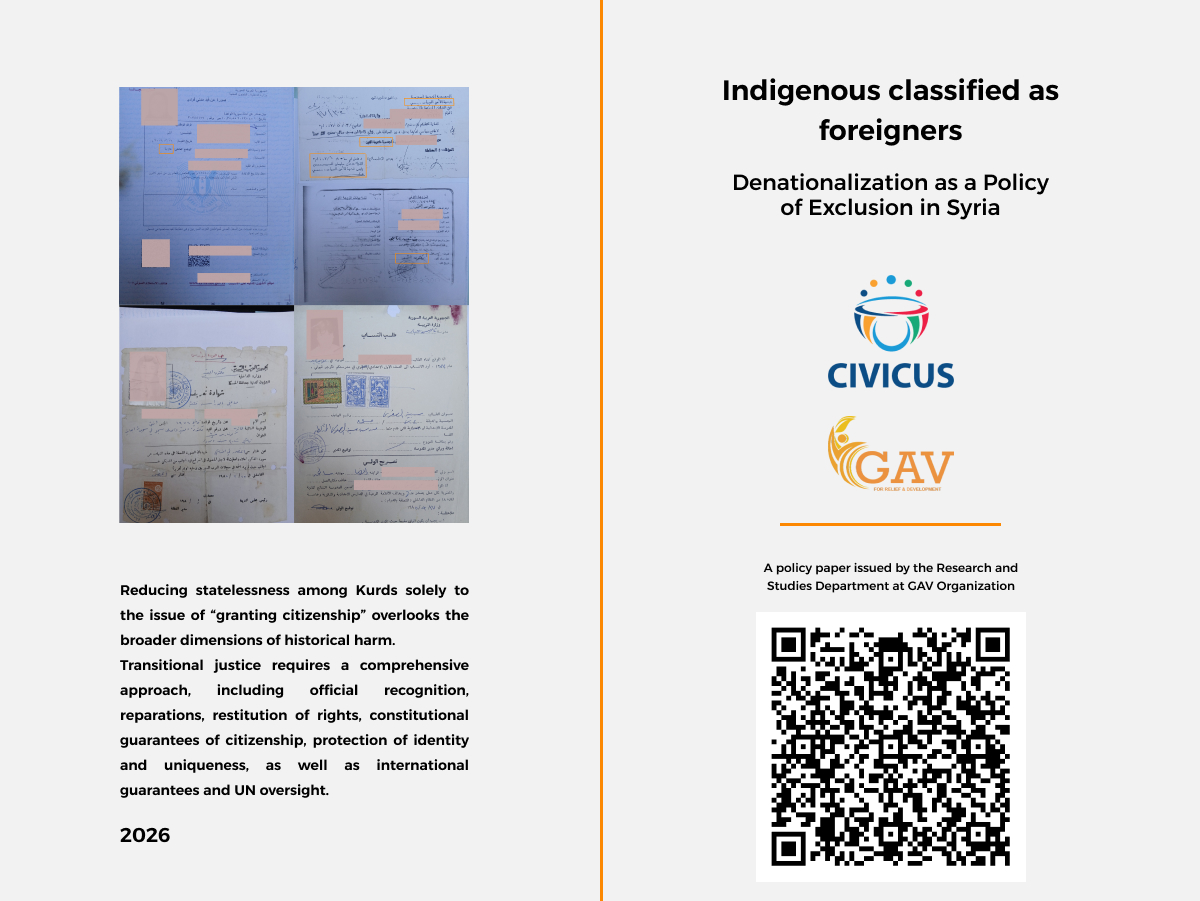
Indigenous classified as foreigners Denationalization as a Policy of Exclusion in Syria
This paper documents the policy of citizenship deprivation applied to tens of thousands of Kurds in Al-Hassakah Governorate in northeastern Syria, beginning with the exceptional census conducted by the Syrian state on a single day, 5 October 1962, pursuant to Legislative Decree No. 93, issued on 23 August of the same year. The census resulted in more than 120,000 Kurds being deprived of Syrian citizenship and classified into two principal categories denied full legal recognition: »Hassakah Foreigners« (stateless persons), who were issued temporary residence cards, and «Maktoumi al-Qayd« (unregistered persons), who were not recorded in any official civil registry. A third category of Kurds retained Syrian citizenship but faced de facto restrictions on their political and economic participation.
The paper brings together three analytical levels. First, it provides a historical and theoretical framework that situates this policy within the trajectory of the formation of the modern Syrian state and examines the concepts of securitization and the state of exception. Second, it provides a legal review of the evolution of successive Syrian constitutions and nationality laws, including the gender dimension reflected in restrictions preventing Syrian women from transmitting their nationality to their children. Third, it incorporates first-hand testimonies documenting the tangible impact of this policy on the rights to education, work, marriage, property ownership, freedom of movement, and civil registration across successive generations.
The paper is based on a review of relevant historical, legal, and legislative documents, as well as approximately 100 interviews with affected women and men, and the outcomes of the Victims’ Forum organized by GAV in Qamishlo. These sources aim to document affected individuals’ experiences and examine the legal, social, and economic consequences associated with the loss of citizenship or the absence of documented nationality. The evidence demonstrates that citizenship deprivation was not a narrowly administrative measure with limited consequences; rather, it contributed to a prolonged condition of legal, social, and economic exclusion whose effects extended to subsequent generations.
The study also identifies a clear gender dimension to the issue. Restrictions arising from nationality laws, civil registration requirements, and the transmission of nationality contributed to the perpetuation of certain forms of statelessness within families across generations, with particularly significant consequences for women and children. The absence of stable legal status further increased the vulnerability of affected families and limited their ability to access rights and economic, social, and civil opportunities on an equal basis.
Decree No. 13 of 2026 represents a significant legal development in addressing the consequences of the 1962 census, through the repeal of the exceptional measures resulting from the census and the regularization of the legal status of affected groups. However, legal redress cannot be achieved through the enactment of legislation alone. Its effective impact depends on the existence of clear, accessible, and practical implementation procedures; affected individuals’ ability to access the competent authorities, obtain official documentation, and establish their rights; and safeguards to ensure that the consequences of statelessness do not persist or pass on to subsequent generations.
Accordingly, the paper concludes that addressing the legacy of citizenship deprivation requires an approach that goes beyond correcting legal status to addressing the consequences accumulated over decades. Such an approach should include the regularization of the status of all affected persons; the facilitation of civil registration and procedures for establishing nationality; measures to address the consequences affecting property ownership and civil and economic rights; safeguards against the intergenerational transmission of statelessness; and a review of the relevant legal frameworks to ensure equality, non-discrimination, and the right to nationality.
Key Recommendations
- Official Recognition of the Violation Formally and explicitly acknowledge the historical violation suffered by affected persons and the consequences it has had on individuals, families, and subsequent generations. Such recognition should acknowledge that the 1962 census and the measures arising from it resulted in the deprivation of citizenship and associated rights, and that this deprivation was not merely an administrative irregularity in civil records, but a practice with far-reaching and enduring legal, social, and economic consequences.
- Ensure the Effective Implementation of Decree No. 13 of 2026 by establishing clear, simplified, and accessible procedures for regularizing the legal status of affected persons, while removing administrative and financial barriers that may prevent them from exercising their rights.
- Regularize the Status of All Persons Affected by the Consequences of the 1962 Census, including those deprived of citizenship and those who were unable to register their civil status, and ensure that these consequences do not continue to affect their children and grandchildren.
- Facilitate Access to Civil Registration and Documentation by adopting flexible procedures for establishing legal identity and nationality, taking into account cases in which individuals lost or were historically unable to obtain official documents as a result of citizenship deprivation.
- Address the Consequences of Deprivation of Property and Economic Rights by establishing effective legal mechanisms for the restitution of rights and property or, where restitution is not possible, providing appropriate forms of reparation.
- Guarantee Equality and Non-Discrimination in Nationality and Civil Registration Laws, including ensuring that legislation and administrative procedures do not create new cases of statelessness and addressing discriminatory provisions and practices that disproportionately affect women and children.
- Adopt Measures to Guarantee Non-Recurrence of Such Practices by protecting the right to nationality and equality before the law, strengthening oversight of the implementation of nationality and civil registration legislation, and ensuring its compliance with applicable human rights obligations.
- Ensure the Meaningful Participation of Affected Women and Men in Relevant Reform Processes and Policy-Making, drawing on their testimonies and lived experiences to assess the implementation of new measures and identify barriers they may encounter.
- Establish Psychosocial Support Centers for Affected Persons and Their Families by providing specialized psychological and social support services that take into account the long-term effects of decades of deprivation and exclusion. Such services should be provided free of charge or at an affordable cost, particularly for women, older persons, and families in which the consequences of citizenship deprivation have extended across successive generations.